Monday, 4 December 2017

SDLC

SDLC is a process followed for a software project, within a software organization. It consists of a detailed plan describing how to develop, maintain, replace and alter or enhance specific software. The life cycle defines a methodology for improving the quality of software and the overall development process.
The following figure is a graphical representation of the various stages of a typical SDLC.


A typical Software Development Life Cycle consists of the following stages −

Stage 1: Planning and Requirement Analysis
Requirement analysis is the most important and fundamental stage in SDLC. It is performed by the senior members of the team with inputs from the customer, the sales department, market surveys and domain experts in the industry. This information is then used to plan the basic project approach and to conduct product feasibility study in the economical, operational and technical areas.

Planning for the quality assurance requirements and identification of the risks associated with the project is also done in the planning stage. The outcome of the technical feasibility study is to define the various technical approaches that can be followed to implement the project successfully with minimum risks.

Stage 2: Defining Requirements
Once the requirement analysis is done the next step is to clearly define and document the product requirements and get them approved from the customer or the market analysts. This is done through an SRS (Software Requirement Specification) document which consists of all the product requirements to be designed and developed during the project life cycle.

Stage 3: Designing the Product Architecture
SRS is the reference for product architects to come out with the best architecture for the product to be developed. Based on the requirements specified in SRS, usually more than one design approach for the product architecture is proposed and documented in a DDS - Design Document Specification.

This DDS is reviewed by all the important stakeholders and based on various parameters as risk assessment, product robustness, design modularity, budget and time constraints, the best design approach is selected for the product.

A design approach clearly defines all the architectural modules of the product along with its communication and data flow representation with the external and third party modules (if any). The internal design of all the modules of the proposed architecture should be clearly defined with the minutest of the details in DDS.

Stage 4: Building or Developing the Product
In this stage of SDLC the actual development starts and the product is built. The programming code is generated as per DDS during this stage. If the design is performed in a detailed and organized manner, code generation can be accomplished without much hassle.

Developers must follow the coding guidelines defined by their organization and programming tools like compilers, interpreters, debuggers, etc. are used to generate the code. Different high level programming languages such as C, C++, Pascal, Java and PHP are used for coding. The programming language is chosen with respect to the type of software being developed.

Stage 5: Testing the Product
This stage is usually a subset of all the stages as in the modern SDLC models, the testing activities are mostly involved in all the stages of SDLC. However, this stage refers to the testing only stage of the product where product defects are reported, tracked, fixed and retested, until the product reaches the quality standards defined in the SRS.

Stage 6: Deployment in the Market and Maintenance
Once the product is tested and ready to be deployed it is released formally in the appropriate market. Sometimes product deployment happens in stages as per the business strategy of that organization. The product may first be released in a limited segment and tested in the real business environment (UAT- User acceptance testing).

Then based on the feedback, the product may be released as it is or with suggested enhancements in the targeting market segment. After the product is released in the market, its maintenance is done for the existing customer base.

SDLC Models
There are various software development life cycle models defined and designed which are followed during the software development process. These models are also referred as Software Development Process Models". Each process model follows a Series of steps unique to its type to ensure success in the process of software development.

Following are the most important and popular SDLC models followed in the industry 

Waterfall Model
Iterative Model
Spiral Model
V-Model
Big Bang Model
Other related methodologies are Agile Model, RAD Model, Rapid Application Development and Prototyping Models.
Tuesday, 9 August 2016

Advantages of Hadoop

  • Hadoop framework allows the user to quickly write and test distributed systems. It is efficient, and it automatic distributes the data and work across the machines and in turn, utilizes the underlying parallelism of the CPU cores.
  • Hadoop does not rely on hardware to provide fault-tolerance and high availability (FTHA), rather Hadoop library itself has been designed to detect and handle failures at the application layer.
  • Servers can be added or removed from the cluster dynamically and Hadoop continues to operate without interruption.
  • Another big advantage of Hadoop is that apart from being open source, it is compatible on all the platforms since it is Java based.

Hadoop - Big Data Solutions

Traditional Approach

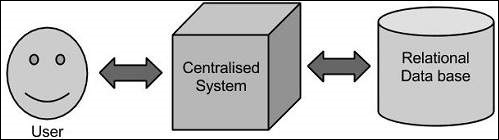
In this approach, an enterprise will have a computer to store and process big data. Here data will be stored in an RDBMS like Oracle Database, MS SQL Server or DB2 and sophisticated softwares can be written to interact with the database, process the required data and present it to the users for analysis purpose.
Big Data Traditional Approach

Limitation

This approach works well where we have less volume of data that can be accommodated by standard database servers, or up to the limit of the processor which is processing the data. But when it comes to dealing with huge amounts of data, it is really a tedious task to process such data through a traditional database server.

Google’s Solution

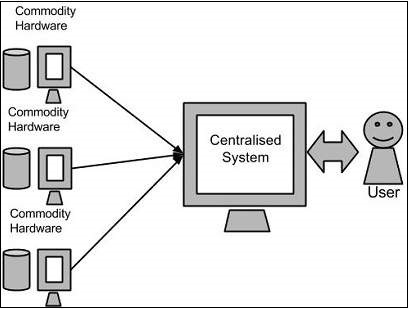
Google solved this problem using an algorithm called MapReduce. This algorithm divides the task into small parts and assigns those parts to many computers connected over the network, and collects the results to form the final result dataset.
Google MapReduce
Above diagram shows various commodity hardwares which could be single CPU machines or servers with higher capacity.

Hadoop

Doug Cutting, Mike Cafarella and team took the solution provided by Google and started an Open Source Project called HADOOP in 2005 and Doug named it after his son's toy elephant. Now Apache Hadoop is a registered trademark of the Apache Software Foundation.
Hadoop runs applications using the MapReduce algorithm, where the data is processed in parallel on different CPU nodes. In short, Hadoop framework is capable enough to develop applications capable of running on clusters of computers and they could perform complete statistical analysis for a huge amounts of data.

HADOOP

Hadoop is an open-source framework that allows to store and process big data in a distributed environment across clusters of computers using simple programming models. It is designed to scale up from single servers to thousands of machines, each offering local computation and storage.
This brief tutorial provides a quick introduction to Big Data, MapReduce algorithm, and Hadoop Distributed File System.

Big Data Technologies

Big data technologies are important in providing more accurate analysis, which may lead to more concrete decision-making resulting in greater operational efficiencies, cost reductions, and reduced risks for the business.
To harness the power of big data, you would require an infrastructure that can manage and process huge volumes of structured and unstructured data in realtime and can protect data privacy and security.
There are various technologies in the market from different vendors including Amazon, IBM, Microsoft, etc., to handle big data. While looking into the technologies that handle big data, we examine the following two classes of technology:

Operational Big Data

This include systems like MongoDB that provide operational capabilities for real-time, interactive workloads where data is primarily captured and stored.
NoSQL Big Data systems are designed to take advantage of new cloud computing architectures that have emerged over the past decade to allow massive computations to be run inexpensively and efficiently. This makes operational big data workloads much easier to manage, cheaper, and faster to implement.
Some NoSQL systems can provide insights into patterns and trends based on real-time data with minimal coding and without the need for data scientists and additional infrastructure.

Analytical Big Data

This includes systems like Massively Parallel Processing (MPP) database systems and MapReduce that provide analytical capabilities for retrospective and complex analysis that may touch most or all of the data.
MapReduce provides a new method of analyzing data that is complementary to the capabilities provided by SQL, and a system based on MapReduce that can be scaled up from single servers to thousands of high and low end machines.
These two classes of technology are complementary and frequently deployed together.

Operational vs. Analytical Systems

OperationalAnalytical
Latency1 ms - 100 ms1 min - 100 min
Concurrency1000 - 100,0001 - 10
Access PatternWrites and ReadsReads
QueriesSelectiveUnselective
Data ScopeOperationalRetrospective
End UserCustomerData Scientist
TechnologyNoSQLMapReduce, MPP Database

Big Data Challenges

The major challenges associated with big data are as follows:
  • Capturing data
  • Curation
  • Storage
  • Searching
  • Sharing
  • Transfer
  • Analysis
  • Presentation
To fulfill the above challenges, organizations normally take the help of enterprise servers.

Benefits of Big Data

Big data is really critical to our life and its emerging as one of the most important technologies in modern world. Follow are just few benefits which are very much known to all of us:
  • Using the information kept in the social network like Facebook, the marketing agencies are learning about the response for their campaigns, promotions, and other advertising mediums.
  • Using the information in the social media like preferences and product perception of their consumers, product companies and retail organizations are planning their production.
  • Using the data regarding the previous medical history of patients, hospitals are providing better and quick service.

Big Data - Structure of DATA

Thus Big Data includes huge volume, high velocity, and extensible variety of data. The data in it will be of three types.
  • Structured data : Relational data.
  • Semi Structured data : XML data.
  • Unstructured data : Word, PDF, Text, Media Logs.

Kiro - Core Features

What is Kiro Kiro is an innovative AI-powered IDE that revolutionizes software development through intelligent assistance and structured wor...